What Is the Difference Between Rekeying and Replacing a Lock Cylinder?
Rekeying keeps your existing lock cylinder but changes its internal key combination so a different key operates it. Replacing the cylinder means removing that cylinder and installing a new one.
In practical terms, if your cylinder is in good condition and your only goal is to make the old key stop working, rekeying is often enough. If the cylinder is worn, damaged, unsuitable for the key system you need, or you want to upgrade the lock itself, replacing it may be the better choice.
At American Star Locksmith, we do not treat every request for new keys as a reason to sell a new lock or cylinder. When we inspect a lock, we first look at what is installed, the condition of the cylinder, and what you are actually trying to solve.
If you need help making that decision, a locksmith in New Jersey can inspect the hardware and determine which option makes sense.
Call American Star Locksmith at (201) 613-2700 and we’ll help you choose the right solution for your door and security needs.
How to Know Whether to Rekey or Replace the Cylinder
What Actually Changes When We Rekey a Lock?
In a typical pin-tumbler cylinder, your key operates a series of small internal pins. The cuts in the key raise those pins to the correct positions, allowing the cylinder to turn.
During a traditional rekey, we keep the cylinder and change the internal pin combination to match a different key.
Once the job is done, the important result is simple: the new key works and the old key no longer does.
Nothing about the outside of the lock necessarily needs to change.
This is why rekeying can be a practical solution when you move into a home, lose control of an existing key, change tenants, or simply do not know who may still have copies.
Rekeying Does Not Mean “Programming” a Standard Cylinder
This distinction is worth making because we often hear mechanical rekeying described as “programming the lock.”
With a conventional pin-tumbler cylinder, there is normally nothing electronic to program.
We physically change the internal keying of the cylinder.
Some modern locks have their own special rekeying mechanisms, and electronic or smart locks may involve programming, but those are different processes.
What Changes When We Replace the Cylinder?
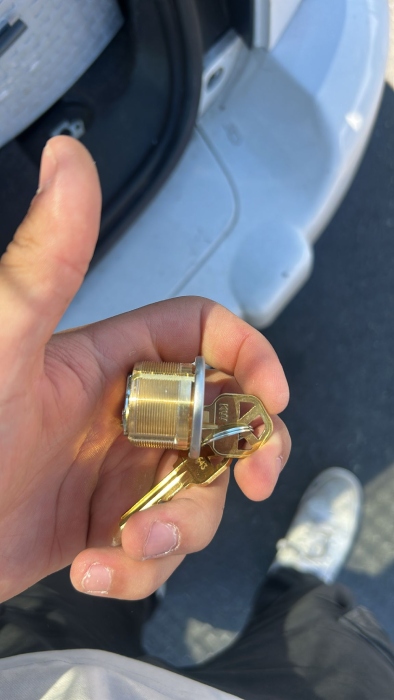
With cylinder replacement, the existing keyed cylinder comes out and another compatible cylinder goes in.
That does not necessarily mean replacing the entire lock.
Depending on the hardware, the handle, lever, deadbolt assembly, mortise lock or other parts may remain in place. If those components are working correctly, there may be no reason to replace them.
This is an important point because customers sometimes call us asking for a “new lock” when what they actually need is either a rekey or a new cylinder.
Our job is to identify which part needs to change before replacing anything unnecessarily.
Can Every Cylinder Be Rekeyed?
No, and this is where looking at the actual lock matters.
Many common residential and commercial pin-tumbler cylinders can be rekeyed. But cylinders are not all built the same way. Different manufacturers and locking systems may use proprietary components, different keyways, interchangeable cores, wafers, special rekeying mechanisms or other designs.
The condition of the cylinder also matters.
A cylinder can sometimes be technically rekeyable but still be a poor candidate for rekeying because it is heavily worn, damaged or becoming unreliable.
That is one of the distinctions we make in the field: “Can this cylinder be rekeyed?” and “Should this cylinder be rekeyed?” are not always the same question.
When Would We Recommend Rekeying?
If we inspect a lock and find a good, properly functioning cylinder that is suitable for the property, we generally see no reason to replace it simply because you need a different key.
Rekeying makes sense when the problem is key control rather than the cylinder itself.
For example, you may have moved into a house and have no way of knowing how many old keys are still in circulation. A former tenant, contractor, previous owner or other person may still have a copy.
In that situation, the existing lock may be perfectly good. What needs to change is which key can operate it.
The same applies if a key is lost and you want to prevent that key from being used.
When Would American Star Recommend Replacing the Cylinder?
We start thinking about replacement when keeping the existing cylinder no longer makes good practical or security sense.
That may be the case when the cylinder is worn, damaged, unreliable, difficult to operate, incompatible with the key system you need, or simply not appropriate for the level of security required at the property.
There is an important security distinction here as well.
Rekeying changes access. It does not upgrade the construction of the cylinder.
If you have a basic cylinder and we rekey it, you still have that same basic cylinder afterward. Rekeying does not suddenly give it better resistance to physical attack or unauthorized key duplication.
So if the reason for calling us is not only “I don’t want the old key to work” but also “I want better protection,” we need to evaluate the cylinder itself rather than automatically rekeying it.
A Good Cylinder Should Not Be Replaced Without a Reason
This is the part of the rekey-versus-replace decision that we think is often overlooked.
If your cylinder operates correctly, is in good condition, can be properly rekeyed, and is appropriate for the door, we do not see value in replacing good hardware simply to change the key.
But we take the opposite position when a cylinder is already worn or unsuitable.
We do not believe in putting new pins into a cylinder that should really be replaced just to make the immediate job less expensive.
The right decision is based on the hardware in front of us.
So, Should You Rekey or Replace Your Cylinder?
Use this as the basic rule:
If the cylinder is good and you only need to change which key opens the door, rekey it.
If the cylinder itself is the problem, or you need a different type or level of security, replace it.
That is how we approach these jobs at American Star Locksmith. Before deciding what to change, we look at the cylinder, how it is operating, the type of lock and the reason you called us.
Sometimes the right answer is a new cylinder.
And sometimes the most professional recommendation is simply to keep the cylinder you already have and rekey it.
Not sure whether your lock should be rekeyed or the cylinder replaced?
Call American Star Locksmith at (201) 613-2700 and we’ll help you choose the right solution for your door and security needs.